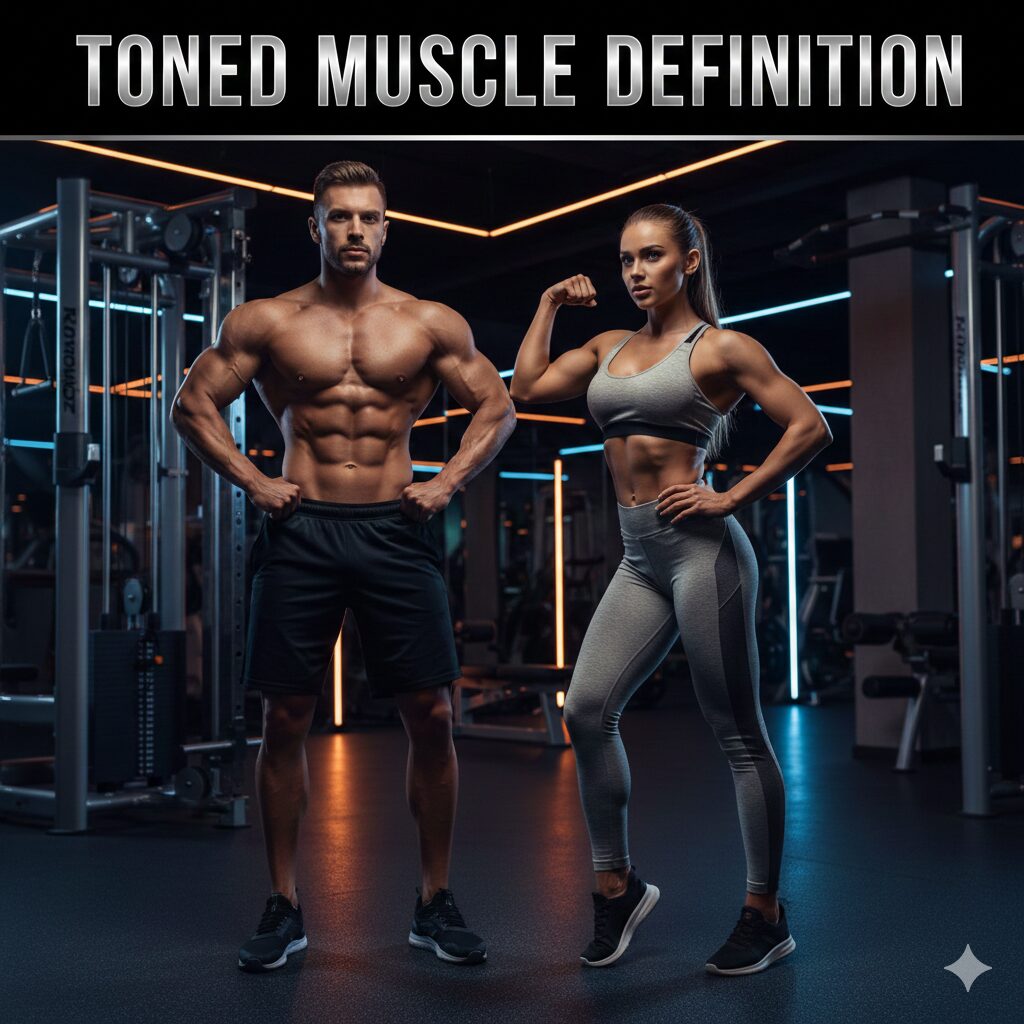
When people say they want to “get toned,” they aren’t usually looking to step onto a professional bodybuilding stage. They are looking for that elusive combination of visible muscle shape, firmness, and athletic leanness.
But what does “toned” actually mean in biological terms? Is it different from building “bulk”? In this comprehensive guide, we’re stripping away the fitness myths to define toned muscles and provide you with a roadmap to achieving that sculpted look.
What is Toned Muscle Definition?
In the fitness world, “tone” is a bit of a colloquialism. Scientifically, muscle tone (physiologically known as tonus) refers to the continuous and passive partial contraction of the muscles. It’s what keeps your body from collapsing into a heap when you’re sitting still.
However, when you talk about toned muscles, you’re likely referring to muscle definition. This is the aesthetic result of two specific factors:
-
Hypertrophy: Increasing the size of the muscle fibers so they have a distinct shape.
-
Low Body Fat Percentage: Reducing the layer of subcutaneous fat that sits between your skin and your muscle.
To put it simply: Definition = Muscle Size + Low Body Fat.
The “Tone vs. Bulk” Myth
One of the biggest hurdles in fitness is the fear of “bulking up” accidentally. Many believe that lifting heavy weights leads to a “bulky” look, while light weights and high repetitions lead to a “toned” look.
The Reality: Muscle is muscle. You cannot change the shape of a muscle fiber to be “long and lean” vs. “short and thick.” Your muscle’s shape is determined by your genetics and where your tendons attach to your bones.
The “bulky” look usually occurs when someone builds significant muscle mass but maintains a higher body fat percentage. The “toned” look occurs when that same muscle mass is paired with a lower body fat percentage.
The Pillars of Muscle Definition
Achieving a defined physique isn’t about one “magic” exercise; it’s a three-pronged approach involving resistance training, nutrition, and recovery.
1. Resistance Training: Building the Foundation
You cannot define what isn’t there. To see muscle, you must first build it.
-
Compound Movements: Focus on exercises that work multiple joints and muscle groups, such as squats, deadlifts, overhead presses, and rows. These provide the most “bang for your buck.”
-
Progressive Overload: To keep seeing results, you must gradually increase the stress placed on the body. This means more weight, more reps, or shorter rest periods over time.
-
Hypertrophy Ranges: Aim for 8–12 repetitions per set. This is the “sweet spot” for muscle growth without necessarily maximizing raw power (1–3 reps) or pure endurance (20+ reps).
2. Nutrition: The “Reveal” Phase
You’ve heard the phrase “Abs are made in the kitchen.” While they are actually built in the gym, they are revealed in the kitchen.
-
The Protein Factor: Protein is the building block of muscle. To maintain muscle while losing fat, aim for roughly 0.8 to 1 gram of protein per pound of body weight.
-
Caloric Balance: To lose the fat covering your muscles, you need a slight caloric deficit. However, a drastic deficit will cause your body to burn muscle for energy, leaving you “skinny-fat” rather than toned.
-
Hydration: Muscles are roughly 75% water. Dehydrated muscles look flat and lose their “pop.”
3. Body Fat Percentages for Definition
While everyone carries fat differently, there are general ranges where muscle definition becomes highly visible:
| Gender | “Toned” Range (Athletic) | High Definition (Leanness) |
| Men | 12% – 15% | 8% – 10% |
| Women | 18% – 22% | 14% – 17% |
The Role of Genetics
It is important to be kind to yourself. Your muscle insertions—where the muscle attaches to the bone—are fixed at birth. Some people have “long” muscle bellies that look full even with less effort, while others have “short” muscle bellies that create deep peaks (like a high bicep ball).
Furthermore, humans are genetically predisposed to store fat in certain areas. You cannot “spot reduce” fat. Doing 1,000 crunches will strengthen your core, but it won’t burn the fat specifically off your stomach. Your body decides where the fat leaves first.
Common Mistakes to Avoid
-
Over-doing Cardio: Excessive steady-state cardio (like hours on a treadmill) can lead to muscle wasting. Prioritize lifting, and use cardio as a tool for heart health and extra calorie burn.
-
Fear of Heavy Weights: Lifting 5lb dumbbells for 50 reps won’t create enough stimulus for the muscle to change. Don’t be afraid to challenge yourself.
-
Lack of Sleep: Muscle tissue repairs itself during deep sleep. If you aren’t sleeping 7–9 hours, you are sabotaging your definition.
Sample “Definition” Weekly Split
If you are looking to start, here is a balanced 4-day “Upper/Lower” split designed to maximize muscle retention and fat loss:
-
Monday: Upper Body (Push/Pull focus) + 15 mins Incline Walking
-
Tuesday: Lower Body (Quads/Glutes focus)
-
Wednesday: Active Recovery (Yoga or Long Walk)
-
Thursday: Upper Body (Shoulders/Arms/Back) + 15 mins Incline Walking
-
Friday: Lower Body (Hamstrings/Posterior Chain)
-
Saturday/Sunday: Rest or light activity
Conclusion
Toned muscle definition is the byproduct of patience and consistency. It isn’t a temporary state reached by a “30-day shred,” but rather the result of building a solid muscular foundation and fueling your body to reveal that hard work.
Focus on getting stronger in the gym, eating adequate protein, and maintaining a sustainable caloric deficit. Before you know it, the “tone” you’ve been looking for will start looking back at you in the mirror.
Read More
How to Fix Muscle Imbalances: The Complete Guide to Symmetry & Strength (2026)
Frequently Asked Questions (FAQ)
Q: Can I get toned without lifting heavy weights?
A: You can improve muscle endurance with light weights, but to achieve “definition,” you need a stimulus strong enough to cause hypertrophy. If the weight doesn’t feel challenging by the last few reps, it’s likely too light to create significant definition.
Q: How long does it take to see muscle definition?
A: This depends on your starting body fat percentage. Generally, with a consistent program and diet, you can see noticeable changes in 8 to 12 weeks.
Q: Is “toning” different for women and men?
A: Biologically, the process is the same. However, men have higher testosterone levels, making it easier to build muscle mass, while women generally need to work harder to achieve the same level of visible muscularity.
Q: Will protein shakes make me bulky?
A: No. Protein shakes are simply a convenient source of protein. Bulking is caused by a large caloric surplus (eating more than you burn), not by protein itself.
Q: Do I need to do “toning” exercises?
A: There is no such thing as a “toning exercise.” There are only exercises that build muscle. To get the toned look, perform standard strength training and manage your body fat through diet.
1 thought on “Best Ultimate Guide to Toned Muscle Definition (2026)”