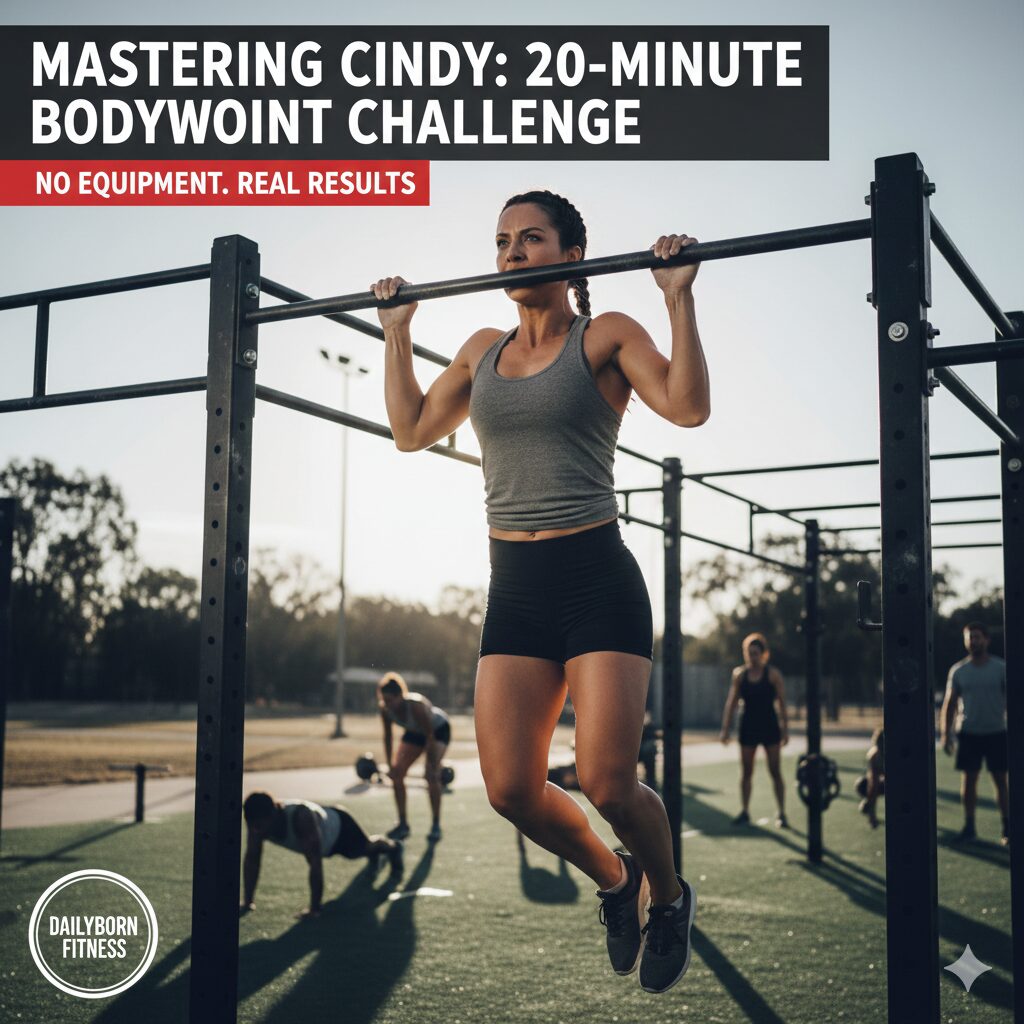
Want a full-body transformation in 20 minutes? Discover the Cindy workout strategy, scaling options, and scoring standards to boost your fitness today.
If you’re looking for a workout that challenges your heart, builds lean muscle, and requires absolutely zero fancy equipment, look no further than Cindy.
Commonly known as one of the CrossFit “Girls” (benchmarks named like storms because they leave you feeling like one hit you), Cindy is the ultimate test of bodyweight endurance. Whether you are a beginner or an elite athlete, this 20-minute session will humble you and help you track your progress like no other.
What is the Cindy Workout?
Cindy is a simple AMRAP (As Many Rounds As Possible) workout. You set a timer for 20 minutes and complete as many cycles as you can of three basic movements:
-
5 Pull-ups
-
10 Push-ups
-
15 Air Squats
There is no programmed rest. You move from the pull-up bar to the floor, to your feet, and back to the bar until the clock hits zero.
The Heroine of Bodyweight Training: A Deep Dive
While most CrossFit workouts involve heavy barbells or specialized equipment, Cindy remains a “Gold Standard” because it measures pure relative strength. Relative strength is your ability to move your own body weight through space. In mathematics, we look at the power-to-weight ratio; Cindy is the ultimate test of that ratio.
By removing external weights, you remove the excuse of “not being strong enough.” Everyone can do a version of Cindy, making it one of the most inclusive yet punishing workouts in existence.
Detailed Movement Standards
To truly “Master Cindy,” you must maintain high standards for every rep. Doing 20 rounds with poor form is less effective than 15 rounds with perfect technique.
-
The Pull-Up: Your chin must clearly pass over the bar at the top, and your arms must reach full extension at the bottom. Whether you use “strict,” “kipping,” or “butterfly” pull-ups, the range of motion must be complete.
-
The Push-Up: Your chest must touch the floor, and your elbows must lock out at the top. Keep your body in a straight line—no “snaking” or sagging hips.
-
The Air Squat: Your hip crease must go below your knee (full depth), and you must stand up completely at the top to open your hips.
The 20-Minute Mental Battle
The first 5 minutes of Cindy feel great. Minutes 5 through 15 are where the “dark place” begins. This is where your aerobic system is taxed, and your muscles begin to fill with lactic acid.
To survive the mental fatigue:
-
Break the 20 minutes into 4 blocks of 5 minutes. Tell yourself to just get through the next block.
-
Focus on the Squats. Use the squats to catch your breath. Shake your arms out during the squats so you are ready for the pull-up bar again.
-
Keep a Chalkboard/Journal. Don’t try to remember your round count in your head; you will lose track by round 10. Mark a line for every round completed.
Nutrition & Recovery: What to do After Cindy
Because of the high volume of push-ups and squats, your muscles will experience significant micro-tears.
-
Immediate Recovery: Spend 5 minutes walking slowly to bring your heart rate down. Follow this with a “Cobra Stretch” for your abs and a “Lat Stretch” for your back.
-
Protein Intake: Aim for 20-30g of high-quality protein within 45 minutes of finishing to jumpstart muscle repair.
-
Hydration: Since this is a high-intensity AMRAP, you will lose a significant amount of electrolytes through sweat. Rehydrate with water and a pinch of sea salt or an electrolyte drink.
Why Cindy Works (The Math of Fitness)
From a mathematical perspective, Cindy is about volume and density.
-
If you complete 20 rounds (a common “Gold Standard” goal), you will have done 100 pull-ups, 200 push-ups, and 300 squats in just 20 minutes.
-
This creates a massive metabolic demand, triggering EPOC (Excess Post-Exercise Oxygen Consumption), which keeps your body burning calories for hours after you finish.
Scaling: How to Make Cindy Work for You
Don’t be intimidated if you can’t do 100 pull-ups yet. The beauty of Cindy is its scalability:
-
Pull-ups: Swap for Ring Rows or use a resistance band for assistance.
-
Push-ups: Perform them on your knees or against a bench (incline push-ups).
-
Time: If 20 minutes is too long, try “Half Cindy” (10 minutes) to build your base.
Strategy Tips for a High Score
-
Don’t Sprint Early: It’s tempting to fly through the first 5 rounds. Don’t. Aim for a pace you can maintain in minute 18.
-
The “Push-up Trap”: Most people fail on the push-ups first. If you know you struggle here, break them into two sets of 5 right from the start to avoid muscle failure.
-
Breathe on the Squats: Use the 15 air squats as your “active recovery.” Control your breathing here so you’re ready to jump back on the bar.
FAQ: Everything You Need to Know
Q: Do I need a gym for the Cindy workout? A: All you need is a pull-up bar! You can do this at a local park, in your garage, or even using a sturdy door-frame bar at home.
Q: What is a “good” score for Cindy? A: * Beginner: 10–12 rounds
-
Intermediate: 13–18 rounds
-
Advanced: 19–24 rounds
-
Elite: 25+ rounds
Q: How often should I do this workout? A: Because it is high-volume, we recommend testing your Cindy score once every 2–3 months to track your fitness improvements.
Conclusion
The Cindy workout is the perfect embodiment of Daily Born Fitness: it’s accessible, efficient, and results-driven. It strips away the excuses of “no time” or “no equipment” and leaves you with a pure test of will. Next time you’re short on time but want a world-class workout, set your timer for 20 minutes and meet Cindy.Mastering the Cindy workout isn’t about being the fastest person in the gym on Day 1. It’s about the math of self-improvement: if you do 12 rounds today and 13 rounds next month, you have improved your fitness by over 8%. At Daily Born Fitness, we celebrate those incremental wins. Grab a bar, set your timer, and let’s see what you’re made of!
1 thought on “Mastering the Cindy Workout: 20 Minutes to Total Body Fitness”