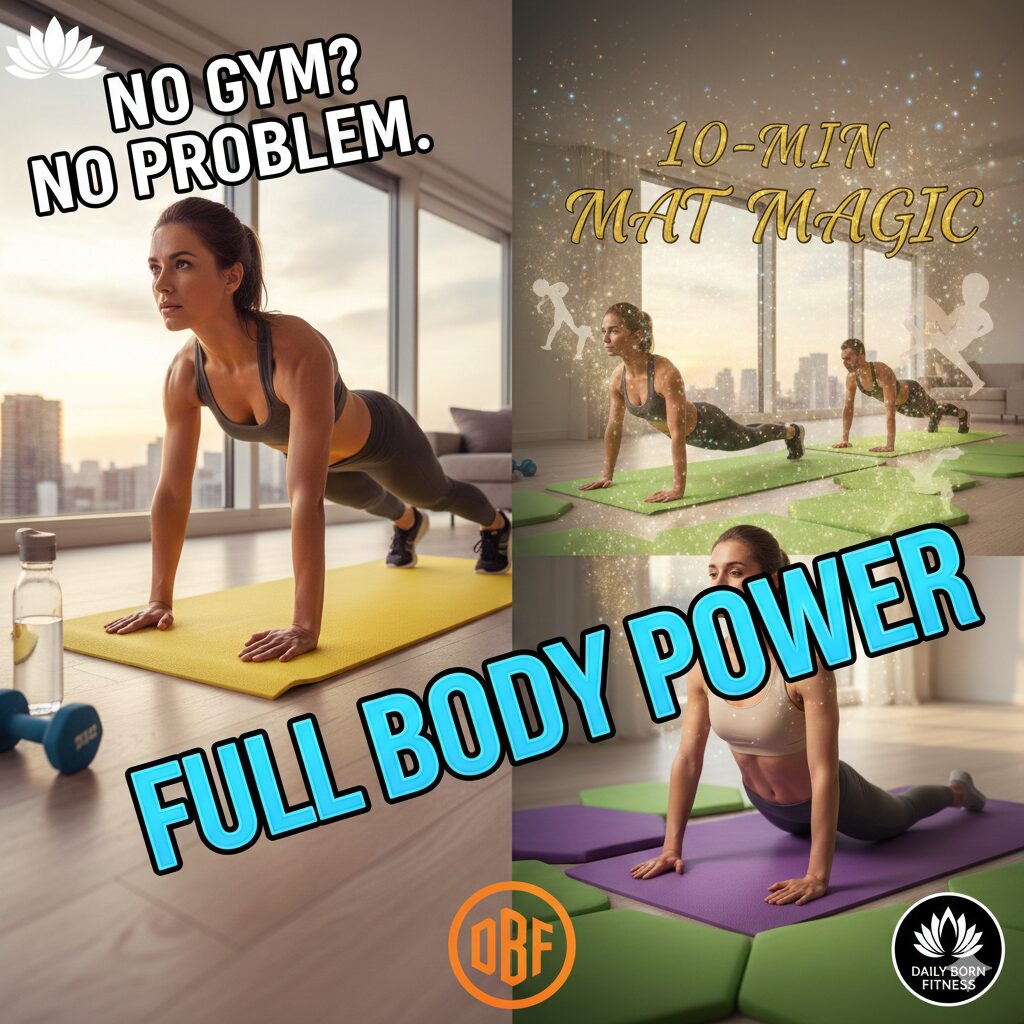
In a world of bulky machines and expensive gym memberships, there is a silent hero in the corner of your room: the exercise mat. Often dismissed as just a “stretching accessory,” the humble mat is actually the foundation for some of the most effective, body-transforming workouts available.
Whether you are a beginner looking to move more or an advanced athlete seeking to bulletproof your joints, exercise mat workouts offer a unique blend of convenience, versatility, and results. In this guide, we will dive deep into why the mat is your most powerful fitness tool and provide a full-body routine you can do anywhere, anytime.
Why Your Workout Needs an Exercise Mat workouts
You might wonder: Why can’t I just work out on the carpet or a towel? While you can, a dedicated exercise mat provides specific benefits that elevate your training from “okay” to “optimal.”
-
Joint Protection: Hard floors are unforgiving on your knees, wrists, and spine. A high-quality mat absorbs impact, allowing you to focus on your form rather than your discomfort.
-
Stability and Grip: Sweat and floorboards don’t mix. A non-slip surface prevents your hands from sliding during a down-dog or your feet from slipping during a high-intensity mountain climber.
-
Defining Your Space: Mentally, unrolling a mat signals to your brain that “workout time has started.” It creates a dedicated zone for focus, even in a cluttered studio apartment.
5 Essential Exercise Mat Workouts for Every Level
The beauty of the mat is its adaptability. You can transition from high-intensity cardio to deep-core Pilates in seconds. Here are five foundational movements to master.
1. The Classic Plank (Core & Stability)
The plank is the gold standard for core strength. On a mat, you can perform this on your forearms without bruising your elbows.
-
How-to: Align your elbows under your shoulders. Keep your body in a straight line from head to heels.
-
Why it works: It engages the entire “posterior chain” and deep abdominal muscles.
2. Glute Bridges (Lower Body & Posture)
Perfect for those who spend all day sitting, this move wakes up the glutes and opens the hips.
-
How-to: Lie on your back, knees bent, feet flat. Lift your hips toward the ceiling while squeezing your glutes.
-
Why it works: It counteracts the “slumping” posture caused by office chairs.
3. Mountain Climbers (Cardio & Agility)
Who says you need a treadmill for cardio?
-
How-to: From a high plank position, drive your knees toward your chest one at a time at a fast pace.
-
Why it works: It skyrockets your heart rate while simultaneously challenging your shoulder stability.
4. Bird-Dog (Balance & Spine Health)
This is a staple in physical therapy and yoga alike.
-
How-to: On all fours, extend your opposite arm and leg simultaneously. Hold for 3 seconds, then switch.
-
Why it works: It improves coordination and protects the lower back.
5. Hollow Body Hold (Advanced Core)
The ultimate test of abdominal endurance.
-
How-to: Lie on your back. Lift your legs and shoulders off the mat simultaneously, forming a “banana” shape. Press your lower back into the mat.
-
Why it works: It builds the functional core strength required for gymnastics and heavy lifting.
Designing Your Routine: From 15 to 45 Minutes
You don’t need hours to see results. Use these structures based on your schedule:
| Goal | Structure | Duration |
| Fat Loss / HIIT | 45 seconds work / 15 seconds rest | 20 Minutes |
| Strength & Tone | 3 Sets of 12-15 Repetitions | 35 Minutes |
| Mobility & Recovery | Slow, controlled flows with 10-breath holds | 15 Minutes |
Read More
Best Ultimate Guide to Toned Muscle Definition (2026)
Conclusion: Your Journey Starts on the Floor
The most common barrier to fitness is the “I don’t have time to go to the gym” excuse. Exercise mat workouts eliminate that barrier entirely. You don’t need a squat rack or a row of dumbbells to build a body that is strong, lean, and resilient. All you need is six feet of space and the discipline to unroll your mat.
By focusing on functional bodyweight movements, you aren’t just burning calories—you’re teaching your body how to move with grace and power. So, what are you waiting for? Your transformation is just one unroll away.
Frequently Asked Questions (FAQ)
What is the difference between a yoga mat and an exercise mat?
Yoga mats are typically thinner (around 3mm to 5mm) to provide “roundedness” for balance poses. General exercise mats (or fitness mats) are usually thicker (10mm to 15mm) to provide more cushioning for high-impact moves and floor exercises like crunches.
Can I lose weight just by doing mat workouts?
Absolutely. By incorporating high-intensity movements like burpees, mountain climbers, and “mat sprints,” you can create a significant caloric deficit. When paired with a healthy diet, mat workouts are highly effective for weight loss.
How do I clean my exercise mat workouts?
Most mats can be cleaned with a simple mixture of water and a few drops of dish soap or white vinegar. Wipe it down after every session to prevent bacteria buildup and prolong the life of the material.
Do I need to wear shoes on an exercise mat?
It depends on the workout. For yoga or Pilates, bare feet are best for grip. For high-intensity HIIT or plyometrics, wearing cross-training shoes can provide better ankle support and prevent the mat from tearing.
1 thought on “The Ultimate Guide to Exercise Mat Workouts: Best Transform Your Home Into a Powerhouse Gym (2026)”