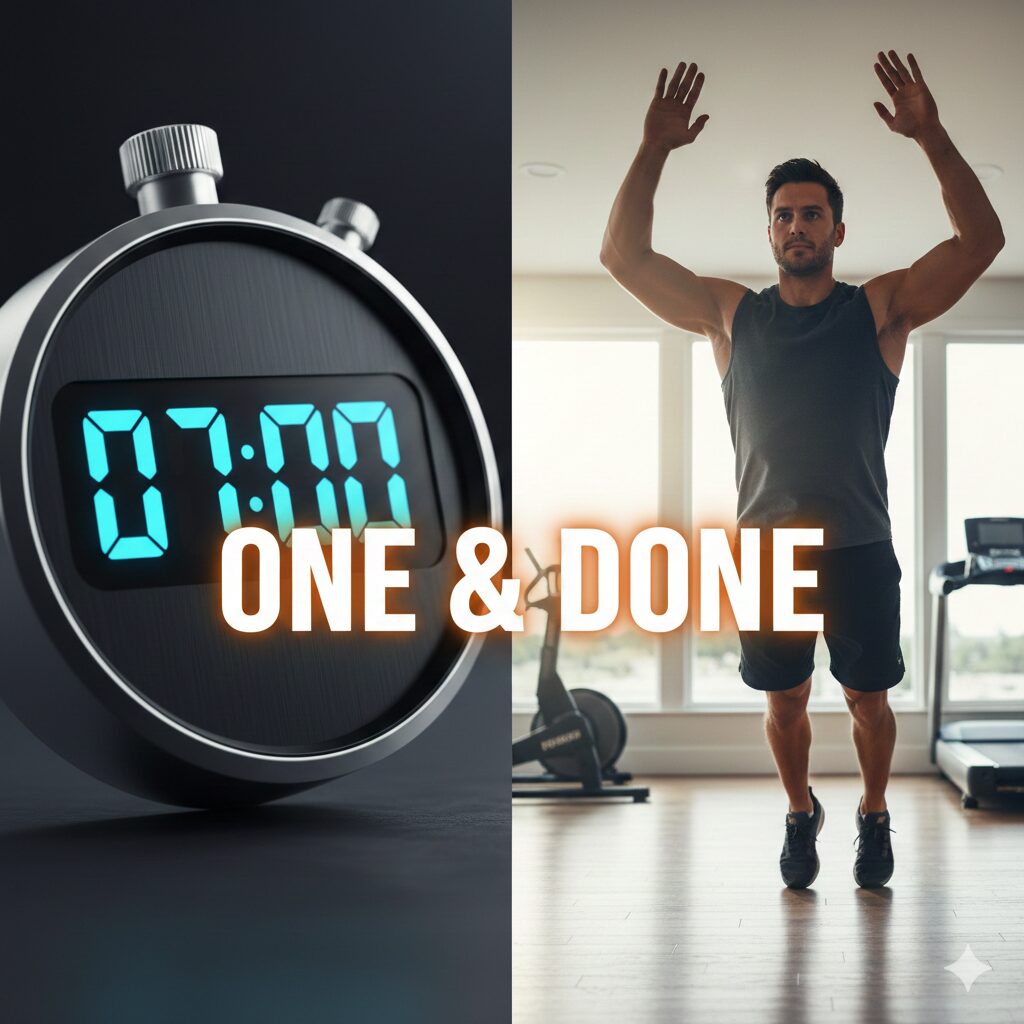
In a world where our calendars are more packed than a morning subway train, the traditional hour-long gym session is starting to feel like a relic of the past. We’ve all been there: staring at a dumbbells rack, calculating if we actually have 60 minutes to spare, and inevitably deciding that “tomorrow” is a better day.
Enter the One and Done Workout.
It’s the fitness trend that promises maximum metabolic impact in the time it takes to brew a pot of coffee. But is it just another “get fit quick” gimmick, or is there actual science backing the idea that you can get results in under 10 minutes? Let’s dive into the mechanics of high-intensity movement and see if this minimalist approach is right for you.
What Exactly is a One and Done Workout?
At its core, the One and Done philosophy is based on S.I.T. (Sprint Interval Training). While most people are familiar with HIIT (High-Intensity Interval Training), S.I.T. takes the intensity a notch higher but shortens the duration significantly.
The concept is simple: you perform a specific movement at 100% maximum effort for a very short burst (usually 20 seconds), followed by a period of active recovery. You repeat this cycle just a few times, and you’re finished.
The Science of “The Afterburn”
The magic isn’t necessarily what happens during those 7 to 10 minutes; it’s what happens for the next 24 to 48 hours. This is known as EPOC (Excess Post-exercise Oxygen Consumption).
When you push your body to its absolute limit, you create an oxygen debt. Your body has to work overtime to restore its internal balance, cool down, and repair muscle tissue. This process requires energy, which means you continue to burn calories at an elevated rate long after you’ve hopped in the shower.
The Benefits: Why People are Ditching the Hour-Long Jog
1. The Ultimate Time-Saver
The most obvious benefit is efficiency. By utilizing a One and Done approach, you eliminate the “I don’t have time” excuse. If you can’t find 10 minutes in your day, your schedule isn’t the problem—your priorities are.
2. Metabolic Rejuvenation
Short, intense bursts of exercise have been shown to improve insulin sensitivity and boost growth hormone levels. This helps your body switch from “storage mode” (keeping fat) to “burn mode” (using fat for fuel).
3. No Fancy Equipment Needed
Most One and Done routines are bodyweight-centric. Squat thrusts, mountain climbers, and high knees are the bread and butter of this program. You can do it in a hotel room, your living room, or even a quiet corner of the office.
4. Cardiovascular Health
Research suggests that brief periods of intense exercise can improve $VO_2$ max—a key indicator of cardiovascular fitness—just as effectively as much longer bouts of moderate-intensity steady-state cardio (like jogging).
How to Do It Right: A Sample 7-Minute Routine
To see results, you can’t just go through the motions. You have to reach a level of intensity where holding a conversation would be impossible.
| Phase | Duration | Activity | Intensity |
| Warm-up | 2 Minutes | Light jogging or arm circles | Low |
| The Burst | 20 Seconds | Sprinting, Burpees, or Mountain Climbers | 100% Max Effort |
| Recovery | 1 Minute | Slow walking or rhythmic breathing | Very Low |
| Repeat | — | Repeat the Burst/Recovery cycle 3 times | High |
| Cool-down | 2 Minutes | Static stretching | Low |
Pro Tip: Focus on form over speed. A “fast” burpee with a sagging back is a recipe for injury. A “powerful” burpee with a tight core is a recipe for results.
Common Myths About Micro-Workouts
Myth #1: “It’s too easy.”
If it feels easy, you aren’t doing it right. The “One and Done” method relies on intensity. If you aren’t breathless and slightly sweaty by the end of your final 20-second burst, you haven’t hit the threshold required to trigger the afterburn effect.
Myth #2: “You can’t build muscle this way.”
While you won’t become a professional bodybuilder using only 7-minute workouts, you can build functional lean muscle. The explosive nature of these movements recruits Type II “fast-twitch” muscle fibers, which are responsible for power and definition.
Myth #3: “It’s only for athletes.”
One of the best things about S.I.T. is that it’s relative. “100% effort” for a 25-year-old athlete looks different than “100% effort” for a 60-year-old beginner. As long as you are pushing your personal limit, the biological benefits remain the same.
Is it Sustainable Long-Term?
Sustainability is the holy grail of fitness. The reason most New Year’s resolutions fail by February is that they require too much friction—driving to the gym, packing a bag, spending 90 minutes away from home.
The One and Done workout has low friction. Because the barrier to entry is so small, you are much more likely to stick with it on days when you’re tired or busy. However, for a well-rounded physique, it is often best to use these workouts as a “metabolic spark” alongside other activities like yoga, walking, or heavy lifting once or twice a week.
The 30-Day Metabolic Spark Challenge
Week 1: The Foundation
Focus: Mastering form and waking up the “fast-twitch” muscles.
| Day | Workout Type | Primary Movement (The Burst) |
| 01 | Introduction | High Knees (20s on / 60s off x 3) |
| 02 | Power | Bodyweight Squats (Fast) |
| 03 | Core Focus | Mountain Climbers |
| 04 | Rest | Active Recovery (15 min walk) |
| 05 | Total Body | Burpees (Modified if needed) |
| 06 | Agility | Lateral Skaters |
| 07 | Power | Speed Lunges |
Week 2: Increasing the “Afterburn”
Focus: Increasing the power output during the 20-second bursts.
| Day | Workout Type | Primary Movement (The Burst) |
| 08 | Rest | Full Rest Day |
| 09 | Explosive | Jump Squats |
| 10 | Upper Body | “Clapping” or Fast Push-ups |
| 11 | Cardio | Shadow Boxing (Max Intensity) |
| 12 | Rest | Active Recovery (Yoga/Stretching) |
| 13 | Core | Plank Jacks |
| 14 | Total Body | The “Classic” Burpee |
Week 3: Peak Performance
Focus: Reducing recovery time slightly or increasing to 4 cycles.
| Day | Workout Type | Primary Movement (The Burst) |
| 15 | Rest | Active Recovery (Walk) |
| 16 | Endurance | Sprint Starts (Stationary) |
| 17 | Power | Tuck Jumps |
| 18 | Total Body | Sprawls (Burpees without the push-up) |
| 19 | Rest | Full Rest Day |
| 20 | Agility | High Knees with Directional Change |
| 21 | Explosive | Alternating Jump Lunges |
Week 4: The Finish Line
Focus: Maximum effort. Leave nothing in the tank.
| Day | Workout Type | Primary Movement (The Burst) |
| 22 | Rest | Active Recovery (Yoga) |
| 23 | Speed | Mountain Climbers (Max Speed) |
| 24 | Power | Broad Jumps |
| 25 | Cardio | Star Jumps (Jumping Jacks on steroids) |
| 26 | Rest | Full Rest Day |
| 27 | Total Body | Burpees + High Knees Combo |
| 28 | Endurance | Bicycle Crunches (Fast & Controlled) |
| 29 | Rest | Light Walking |
| 30 | The Finale | The “Gauntlet”: 1 cycle of 4 different movements |
3 Rules for Success During This Challenge
-
The 2-Minute Warm-up is Non-Negotiable: Because you are going from 0 to 100, your muscles need to be warm to prevent strains. Never skip the arm circles and light jogging.
-
Hydrate for the Afterburn: Your metabolism will be elevated. Drink at least 500ml of water immediately after your session to assist in the recovery process.
-
Log Your “Feel”: Since you aren’t counting reps, rate your intensity from 1–10. If you aren’t hitting an 8 or 9 by the final burst, push harder tomorrow.
Read More
The Ultimate 20-Minute Chicken Broccoli Rice Recipe: Healthy & Flavorful
Conclusion: Small Effort, Big Impact
The One and Done workout isn’t a magic pill, but it is a scientifically sound method for improving health in a time-crunched world. It challenges the “more is always better” mindset and replaces it with “better is better.” By focusing on quality and intensity over raw duration, you can reclaim your time without sacrificing your health goals.
If you’re tired of the “all or nothing” approach to fitness that usually ends in “nothing,” give the one-and-done method a try. It’s only seven minutes. You’ve probably spent more time than that scrolling through your phone this morning!
Frequently Asked Questions (FAQ)
Q: Can I do this every day?
A: Because of the high intensity, your central nervous system needs time to recover. It is generally recommended to do these 3–4 times a week rather than every single day.
Q: Do I need to be in shape to start?
A: No. However, you should consult with a doctor if you have underlying heart conditions. Start at a pace that is “hard for you” and increase the power as your fitness improves.
Q: Will this help me lose weight?
A: Yes, primarily through the EPOC effect and improved metabolic flexibility. However, no workout can outrun a poor diet. Pair this with whole foods for the best results.
Q: What is the difference between HIIT and S.I.T. (One and Done)?
A: HIIT typically involves longer intervals (30–60 seconds) at 80–90% effort. S.I.T. involves shorter intervals (20 seconds) at 100% total maximum effort.
1 thought on “The “One and Done” Workout: Is 7 Minutes Really Enough to Transform Your Body?”