For decades, the Smith machine has been a polarizing fixture in the fitness world. Purists often dismiss it in favor of free weights, while beginners and bodybuilders swear by its stability. But if you are looking to build a physique that is both strong and safe, understanding how to leverage this machine is a game-changer.
In this comprehensive guide, we’ll dive deep into everything you need to know about the Smith machine—from its unique benefits to the best exercises and common pitfalls to avoid.
What is a Smith Machine?
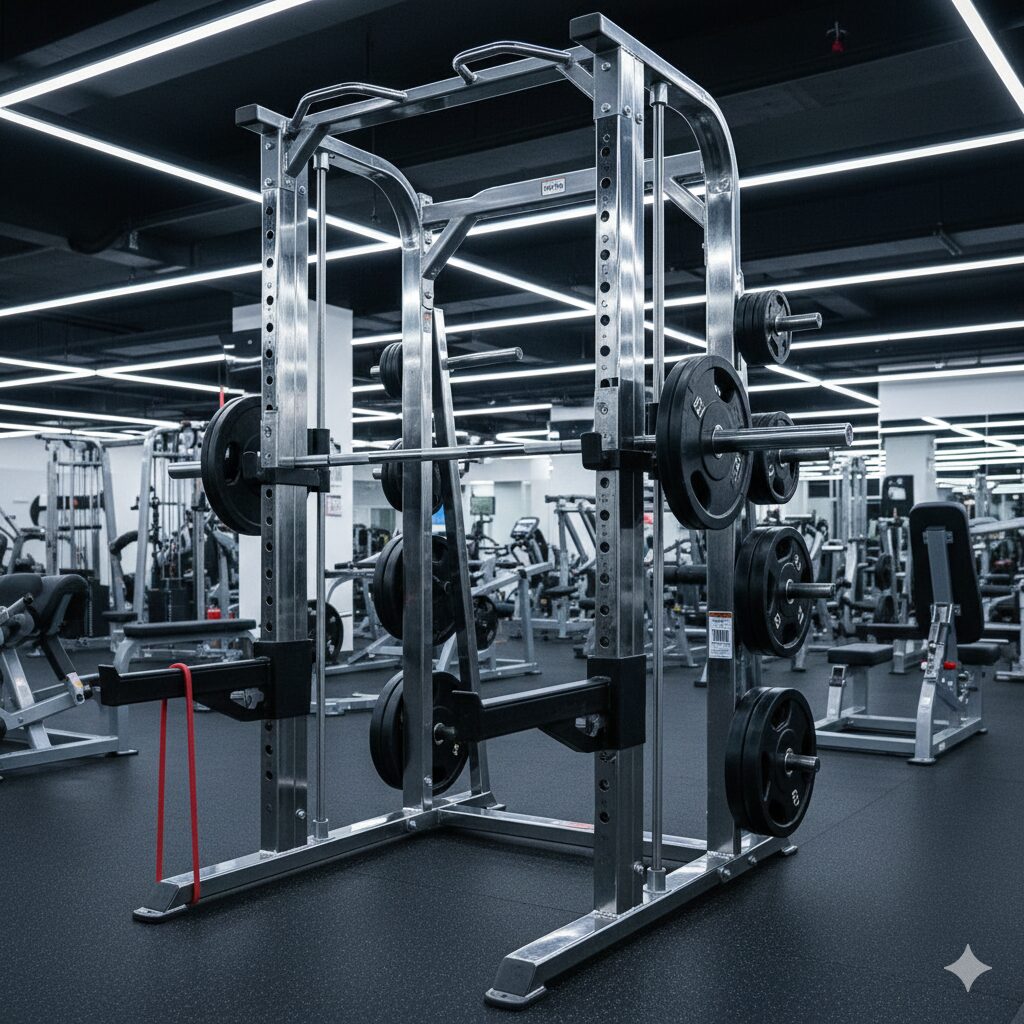
At its core, a Smith machine is a weight-training apparatus consisting of a barbell fixed within steel rails, allowing only for vertical or near-vertical movement. Unlike a traditional squat rack, the bar on a Smith machine is on a track. This “guided” path eliminates the need for you to balance the weight horizontally, letting you focus entirely on the vertical drive.
Types of Smith machines
The normal vertical machine and the angled variation (seen above) are the two most popular varieties of Smith machines.
Standard Vertical Smith Machine
Only straight up-and-down movements are possible with the conventional Smith machine. For people who wish to perform variations of fundamental weightlifting exercises like hack squats and single-leg deadlifts, it’s a fantastic choice.
Angled Smith Machine
With the exception of the barbell’s slightly slanted route, which more closely resembles the body’s natural lifting motions, an angled Smith machine is quite identical to a regular vertical machine.
How much does a Smith machine barbell weigh?
Depending on the manufacturer, the bar’s actual weight varies, although it typically ranges from 20 to 45 pounds. Since the bar is attached to the machine and glides on and off the side bars while in motion, the amount of friction can alter how heavy the bar feels. The bar may seem lighter and move more readily if the machine has recently been serviced or lubricated. And of course, you may add and remove weight plates as you go.
The Anatomy of the Machine
-
The Guided Bar: Moves smoothly along a track.
-
Safety Hooks: Located every few inches, allowing you to “re-rack” the bar with a simple flick of the wrist.
-
Counterbalance (Optional): Many modern machines have a system that reduces the “starting weight” of the bar, making it ideal for rehab or beginners.
Why Use a Smith Machine? (The Benefits)
1. Enhanced Safety for Solo Lifters
The most significant advantage is the built-in safety. Because the bar can be locked at any point during the rep, you can train to muscular failure without a spotter. If you can’t complete a rep, you simply rotate the bar to hook it back onto the frame.
2. Superior Muscle Isolation
Since the machine handles the stabilization for you, your body doesn’t have to recruit as many “stabilizer muscles” to keep the bar steady. This is a massive benefit for bodybuilders who want to isolate specific muscle groups like the quadriceps or upper chest without being limited by balance.
3. Perfect for Rehabilitation and Beginners
If you are recovering from an injury or are brand new to the gym, the Smith machine provides a “low-stakes” environment to learn movement patterns. It builds the necessary confidence and base strength before you transition to more complex free-weight movements.
Top 5 Smith Machine Exercises for Maximum Gains
To get the most out of your “Daily Born Fitness” routine, try these high-impact movements:
1. Smith Machine Squats (Quad Emphasis)
By placing your feet slightly in front of the bar, you can keep your torso more upright than in a traditional squat. This shifts the tension directly onto the quadriceps.
-
Pro Tip: Don’t lock your knees at the top; keep constant tension on the muscle.
2. Incline Bench Press
The fixed path is perfect for the incline press. It ensures the bar stays aligned with your upper chest, preventing the “drift” toward the chin that often happens with heavy dumbbells.
3. Bulgarian Split Squats
This is arguably the best use for a Smith machine. Balancing on one leg with a heavy barbell is difficult; the Smith machine removes the wobble, allowing you to load the movement much heavier and torch your glutes and quads.
4. Bent-Over Rows
Using the Smith machine for rows allows for a strictly vertical pull. This helps in maintaining a flat back and prevents you from using momentum to “swing” the weight up.
5. Calf Raises
The Smith machine is the gold standard for calf raises. You can load significant weight and focus entirely on the deep stretch and peak contraction at the top.
Disadvantages of using a Smith machine
Fixed path: Although the fixed barbell path has certain benefits, it can also have drawbacks, particularly when it comes to specific workouts.
Reduced efficacy: Smith machines could make exercises seem simpler to perform, but they might also be less efficient. Your muscles aren’t activated as much or in the same way as they could be if you don’t have the range of motion that free-weight workouts provide.
Potentially less increase in stability overtime: Because balance isn’t as much of a priority when using the Smith machine as compared to free weights, you’re actually losing out on the chance to create stability in your core when you have the machine do the job for you.
Common Mistakes to Avoid
Despite its guided nature, you can still get injured if you use the Smith machine incorrectly.
-
Ignoring Natural Biomechanics: Your body naturally moves in a slight curve during a bench press (a “J” shape). Since the machine is vertical, you must position your body so the bar path feels natural for your joints.
-
Relying on it Exclusively: While great for isolation, don’t forget free weights. You still need to train your stabilizers for “real-world” functional strength.
-
Facing the Wrong Way: Some Smith machines are set at a 7-degree angle. Depending on the exercise (like a squat), you should face the direction that allows the bar to travel down and back to mimic your natural hip hinge.
Conclusion
The Smith machine is not a “cheating” tool; it is a high-precision instrument for hypertrophy and safety. Whether you are a beginner looking for stability or an advanced lifter aiming to push past a plateau, it deserves a spot in your program. By focusing on proper foot placement and using the machine to isolate your target muscles, you can achieve incredible results while minimizing the risk of injury.
Frequently Asked Questions (FAQ)
Q: Is the bar on a Smith machine 20kg? A: Not always. Because of the track system and counterbalances, the “effective” weight of a Smith machine bar can range from 0kg to 15kg. Always check the sticker on the side of the machine.
Q: Is it better for weight loss? A: Weight loss is driven by a caloric deficit, but the Smith machine helps by allowing for high-intensity, muscle-building workouts that boost your metabolism.
Q: Can I do deadlifts on a Smith machine? A: You can do “Rack Pulls” or Romanian Deadlifts (RDLs), but a traditional floor-to-hip deadlift is restricted by the machine’s fixed path and may not feel natural.
Q: Why do I lift more on the Smith machine than with free weights? A: Because you aren’t spending energy stabilizing the bar. All your effort goes into the primary movers, which usually results in higher numbers on the rack.
Read More
Nature’s Fastest-Growing Tissue: The Ultimate Guide to Deer Antler Velvet for Recovery and Vitality
1 thought on “Smith Machine Guide: 5 Science-Backed Benefits & Best Exercises for Gains”